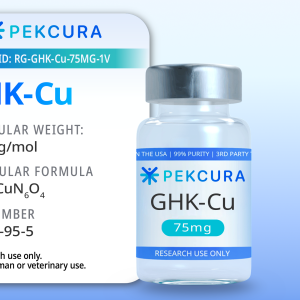
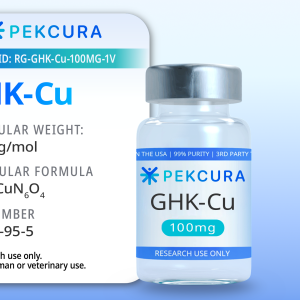
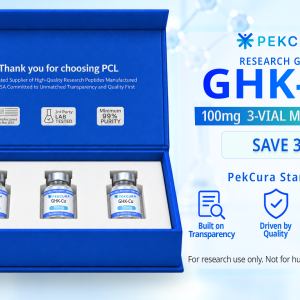
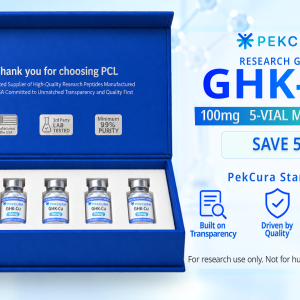
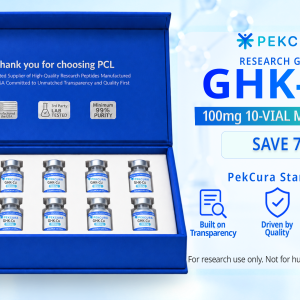
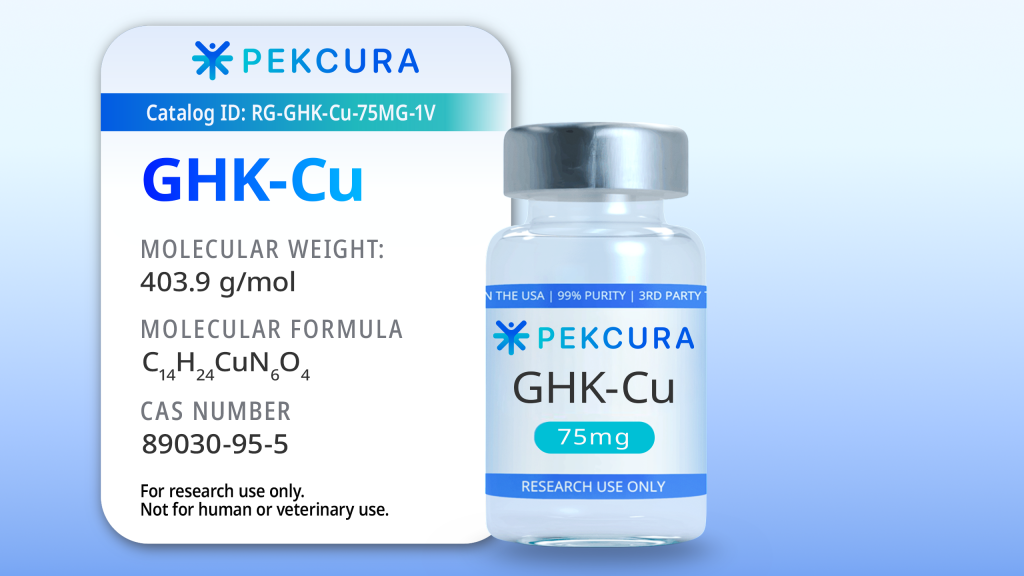
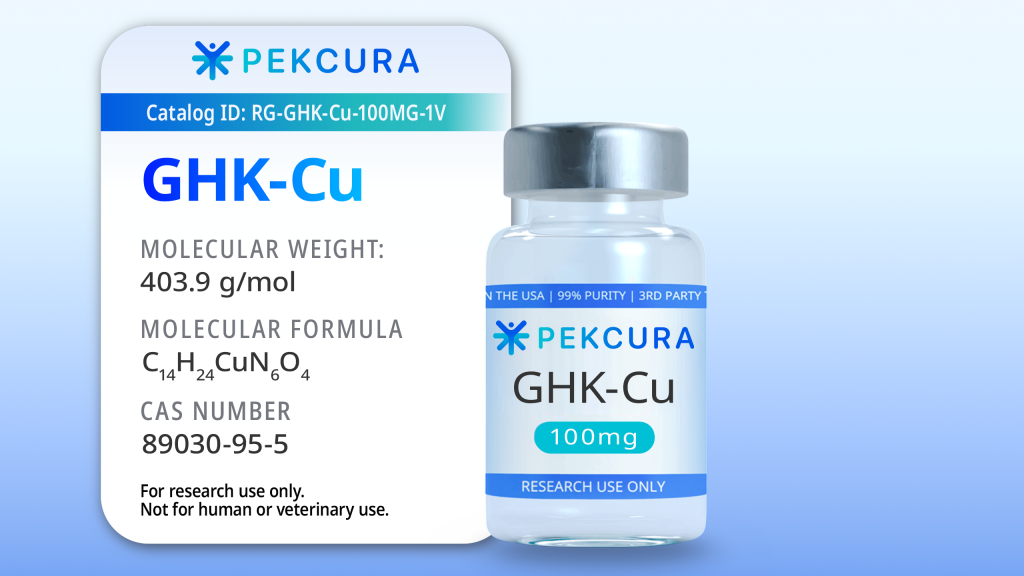
GHK-Cu, the copper(II) complex of glycyl-L-histidyl-L-lysine, is a synthetic research peptide supplied as a lyophilized powder for laboratory and analytical research. Each lot is independently tested by an ISO/IEC 17025:2017-accredited laboratory, with current and historical lot specific results documented in the PekCura Labs COA Library. Research Grade GHK-Cu is intended solely for laboratory, analytical, and scientific research, not for human or veterinary use.
First identified by researcher Loren Pickart in 1973, GHK is known for its strong, ready affinity for copper. Copper (II) is held within the tripeptide through nitrogen atoms from the histidine imidazole side chain, the glycine amino terminus, and a deprotonated backbone amide nitrogen, forming a coordination geometry characterized by X-ray spectroscopy (Kremennaya et al. 2017). This coordination pattern, known in peptide chemistry as an ATCUN motif (Amino-Terminal Cu(II)/Ni(II)-binding), is what gives GHK-Cu its characteristic sapphire-blue to blue-violet color. Within this complex, the Cu²⁺ ion has an unfilled d-orbital with a d⁹ electronic configuration, which allows for specific electron transitions. When white light passes through the complex, the copper ion absorbs wavelengths in the yellow-red part of the visible spectrum, while the unabsorbed wavelengths, predominantly blue and violet light, are reflected or transmitted back to the eye.
Every lot of GHK-Cu at PekCura Labs is third-party tested by an independent, ISO/IEC 17025:2017-accredited laboratory, and is evaluated across six categories: identity by LC-MS, purity and quantity by HPLC-UV-Vis, sterility per USP <71>, endotoxins by LAL assay, and heavy metals by ICP-MS. PekCura Labs maintains a minimum 99% purity standard, and the reported results are published in a lot-specific GHK-Cu COA that can be accessed anytime in our COA Library, or by scanning the QR code located on the vial or product box. This lot-specific documentation connects the material supplied with the analytical results reported for that batch.
PekCura Labs supplies research grade GHK-Cu solely as research-use-only laboratory material. It is not intended for human or veterinary use.
References
- Kremennaya, M.A., Soldatov, M.A., Podkovyrina, Y.S., Dadasheva, I.A., and Soldatov, A.V. 2017. “X-ray Spectroscopy Study of the Cu(II)GHK Peptide Complex.” Journal of Structural Chemistry 58(6): 1213–1219. doi.org/10.1134/S0022476617060208
Synthetic Peptide
3
Gly-His-Lys
Deep blue to violet lyophilized material with variable cake/powder presentation, supplied in a 3 mL glass vial.
Refrigerate at 2–8°C (36–46°F) in a dry, protected environment.
Store frozen at −20°C or below, avoiding repeated freeze-thaw cycles, for extended storage.
Protect from moisture, direct light, and unnecessary temperature fluctuations.
Why is GHK-Cu blue to violet in appearance?
GHK-Cu is typically blue to violet because it is a copper(II)-peptide complex. Copper(II) coordinates with the tripeptide glycyl-L-histidyl-L-lysine, changing how the complex absorbs visible light, producing its characteristic color. This copper-associated appearance is why GHK-Cu is sometimes called a blue copper peptide in scientific literature. Shade and intensity may vary slightly between lots. Color alone should not be used to assess identity or purity; those specifications are confirmed through lot-specific LC-MS and HPLC-UV-Vis testing.
Is GHK-Cu available in a GMP Manufactured version?
Yes. PekCura Labs offers both Research Grade and GMP Manufactured GHK-Cu. GMP Manufactured GHK-Cu is produced in a GMP-certified facility using documented current Good Manufacturing Practice (cGMP) controls. The Research Grade version is not supplied with the GMP Manufactured designation; however, both grades undergo the same independent, lot-specific testing for identity, purity, quantity, sterility, endotoxins, and heavy metals. See the
GMP Manufactured GHK-Cu product page for available GMP Manufactured vial amounts, and testing documentation.
Is GHK-Cu third-party tested?
Yes. Every lot of PekCura Labs GHK-Cu undergoes independent third-party testing by an ISO/IEC 17025:2017-accredited laboratory. Testing covers six categories: identity, purity, quantity, sterility, endotoxins, and heavy metals. The laboratory uses LC-MS to verify identity, HPLC-UV-Vis to measure purity and quantity, USP <71> testing for sterility, LAL testing for endotoxins, and ICP-MS for heavy metals. This six-category testing provides a more complete analytical profile than purity testing alone. Lot-specific GHK-Cu test results are available in the
QC panel above.
Where can I find the Certificate of Analysis for GHK-Cu?
A lot-specific GHK-Cu Certificate of Analysis (COA) can be accessed by scanning the QR code on the vial label. The QR code opens the testing record associated with the lot number printed on that vial. Additionally, all published
GHK-Cu Certificates of Analysis can be searched by lot number in the PekCura Labs COA Library. Each published COA contains results from an independent, ISO/IEC 17025:2017-accredited laboratory and corresponds to a specific GHK-Cu lot.
3D model shown is the parent tripeptide (GHK); a distinct public structure for the copper complex (GHK-Cu) is not available.